Vaasa, Prague
Byte-powered Future
Wellbeing services counties are under continuous budget pressure, and real estate — hospitals, health centers, rehabilitation units, and other care facilities — is one of the largest cost items under review. We can see this clearly in Finland, as well as in other countries. Decisions about which facilities to keep, close, or consolidate are hard to make well, because they sit at the intersection of building costs, the services delivered at each site, how patients actually flow through the network, and the staff needed simply to keep a facility running. These factors are usually tracked in separate systems, if they are tracked in a comparable way at all, which makes trade-offs difficult to see and even harder to justify publicly. This topic was raised in a discussion with a wellbeing services county exploring how facility decisions are currently made and what a more structured, model-based approach could look like.
Goal
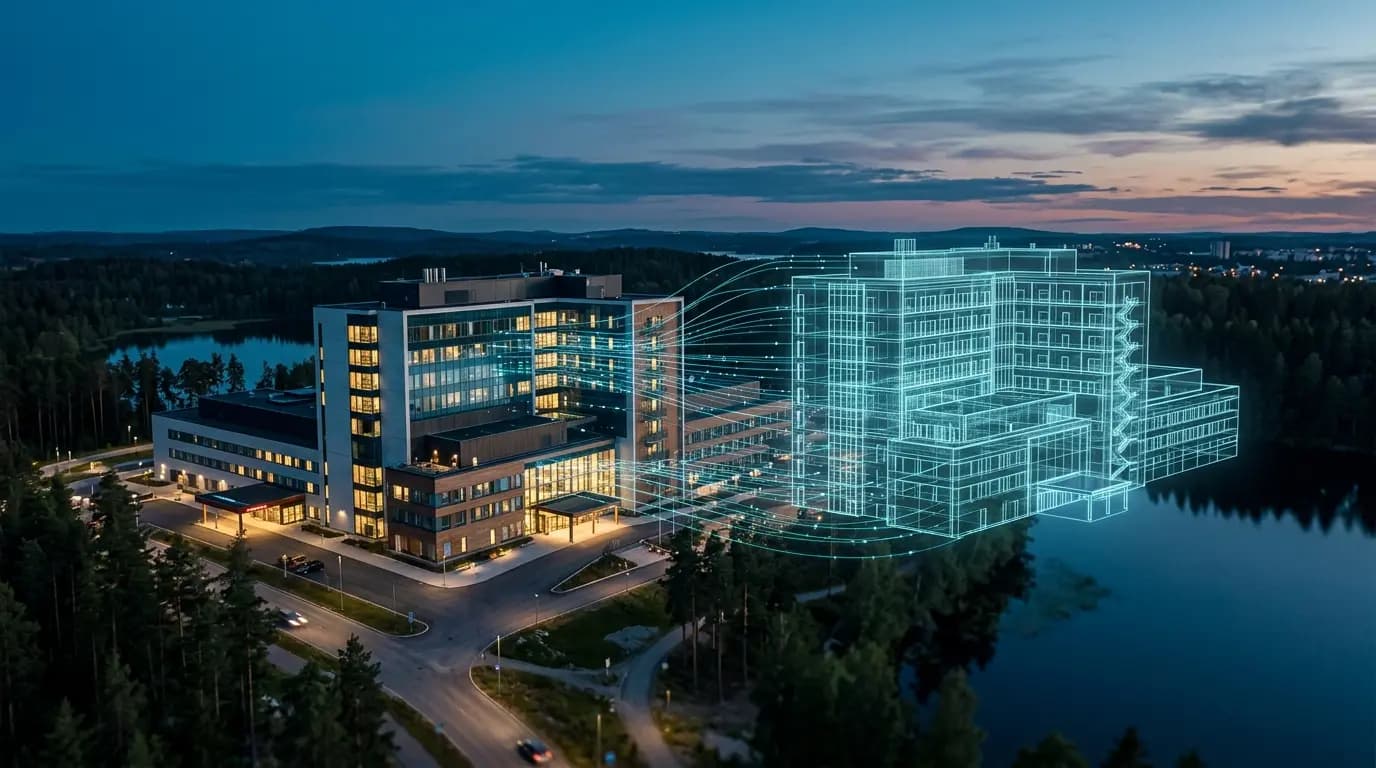
Prototype a digital twin of a wellbeing services county's real estate portfolio, and use it to run comparative scenarios that support a facility-level decision — for example: where are the largest cost-saving opportunities, and which facilities could be closed, consolidated, or kept, and on what basis. The emphasis is on the model and the scenarios it enables, not on visual or architectural fidelity. A structured, queryable representation of a facility is more useful here than a 3D render.
Scope of the project
Rather than modeling an entire real estate portfolio, the team should start from a single, concrete case: one facility being considered for consolidation, or a small comparison set of two to four facilities of different types (for example, a main hospital site, a health center, and a smaller specialized unit). A working model of one well-chosen case, tested against real scenario questions, is more valuable than a shallow model of everything.
- Building a structured digital twin of the selected facility or facilities, covering space use, running costs, services offered, patient volumes, and staffing needs
- Designing at least two comparable "what-if" scenarios (for example: consolidating one facility's services into another, or reducing opening hours at a given site) and showing their modeled impact side by side
- Producing a working prototype — a dashboard, an interactive spreadsheet model, or a simple application — that a facility planner could use to explore further scenarios themselves

VP
+358 40 661 9940
janne@demola.net

Head of Talent Development
+358 40 631 4029
jere@demola.net
Facilitator, Czechia
+420774537011
petra@demola.net
Apply by
26 Oct 2026
Location
Vaasa
Teamwork
In person
Language
English
Project starts
29 Sept 2026
Kick-off
29 Sept 2026
Final session
23 Nov 2026
Project ends
23 Nov 2026
#dashboards
#digital twin
#healthcare
#real estate
#simulation
